I’m finding this more academic than I expected but loving it all the same. I’m particularly taken with the Wolf Kahn and Hans Hoffman works, and some of the gentler abstract expressionist works. I sometimes forget what a profound impact colour has on me though. I read this till about 10pm then spent half the night with possible paintings dancing in front of me, and vivid colour schemes making my brain as far from relaxed as I could possibly get!
I’m wanting to do a new, large-scale, painting for our kitchen and am thinking about really strong colours along the lines of those used on the book’s cover. I might even work in pastels instead of acrylics for a change. We’ll see … I need some peaceful sleep first though.
I’ve starting making trial signatures for a swap I’m involved in. We each make 11 sets of signatures, and send off by the 20th Sept, and signatures back from a variety of amazing artists. You can see more about it here.
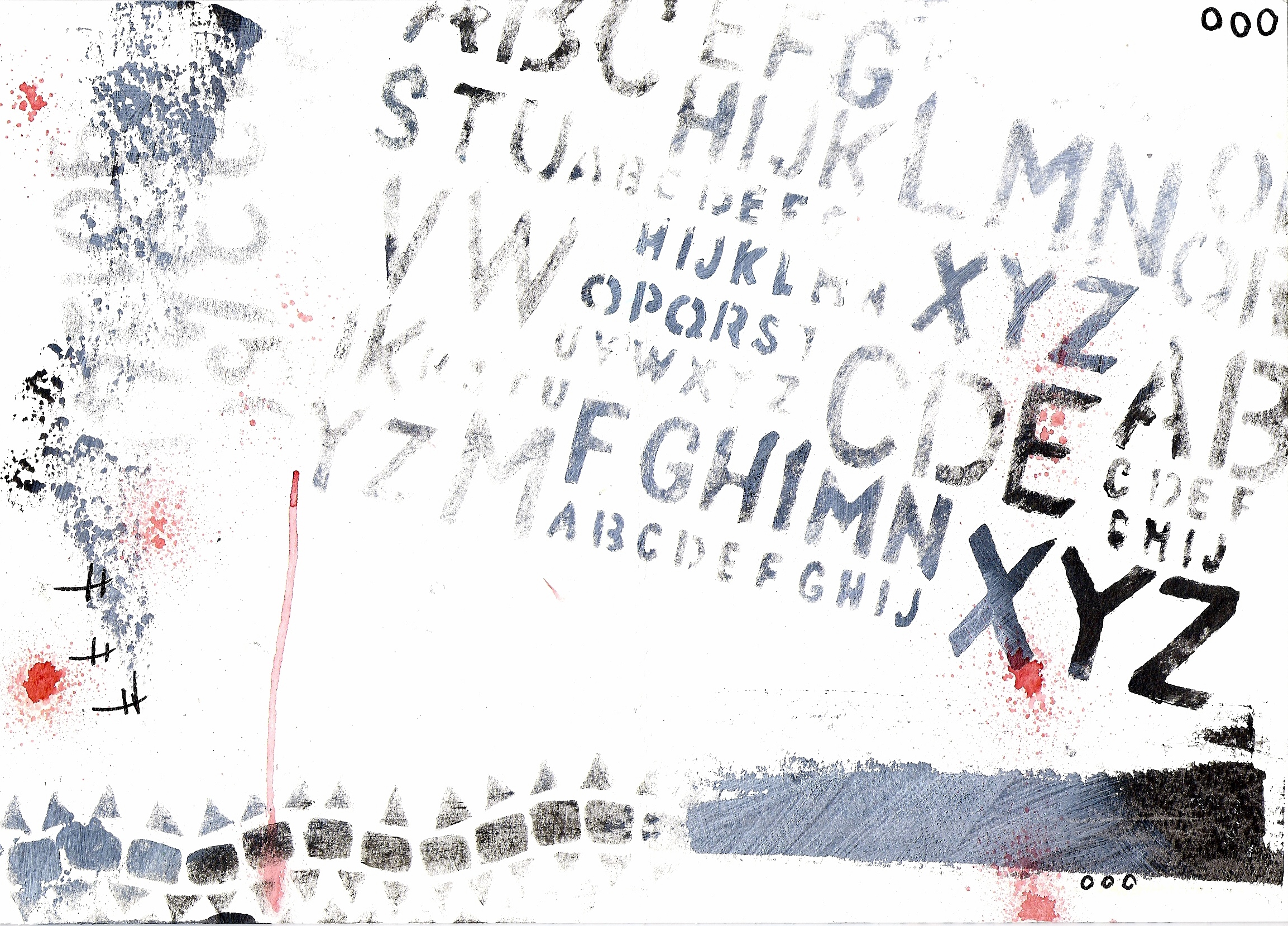
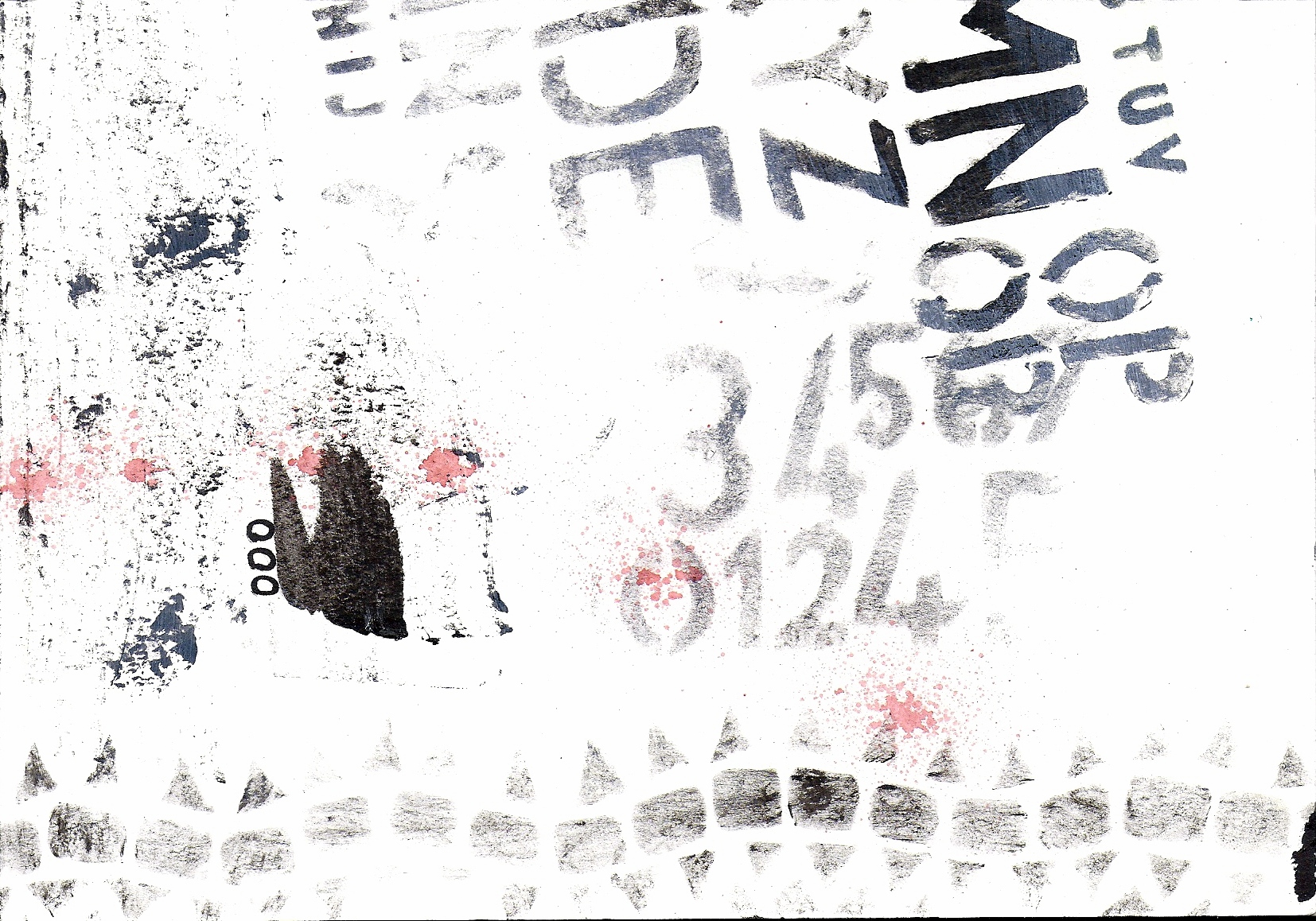
I have been playing with some quite heavy watercolour paper, and have decided it is a bit *too* heavy. The other day I ordered some lovely paper from Gordon Harris, and I’m going to have a play with those tomorrow. I’ve got some mixed media paper, rice paper, watercolour paper and one other – escapes me for the moment just what it was. So far I have stuck with black, white and red, and have been using foam stamps, old credit cards, a spray bottle, stencils and marker pens. The mark making is too dark for the look I want; tomorrow’s lot will be a bit less obvious. Here’s what I have been doing so far:
Yesterday I spent the day at the rest home with my Aunt. They thought she had a chest infection and I had some very hard decisions to make. Turns out she had aspirated some of her Nutrisip, so crisis averted for now, although the aspirated drink may yet cause pneumonia. The Doctor and I have agreed that we will not treat her if she does develop a chest infection or pneumonia. It’s a hard decision to make fr another human being. But Aunty Julia has late stage Dementia and no quality of life. I was dithering a bit and he asked me “if we save her, what does she have to look forward to?”. Nothing – she can’t move on her own, doesn’t talk etc. So I sat with her, giving her sips of drink, reading my book and talking idly to her. What else can you do. Life can be messy and hard, but with love and patience, there’s a way forward.
And so it is with my art. My desk is a shambles but it is not really as chaotic as it looks. I am working on my journal, trying out some ideas for an exhibition in May, and filing odd bits and pieces I want to use at a later date (into gorgeous new brightly coloured paper folders I bought the other day). All of a sudden the desk will clear and order will be restored. I need to spend some creative time out today. Yesterday was hard, I called a family member who lives 4 hours away and they have come up for 36 hours for what is probably a last visit. I will leave her care with them today and take over the reigns again tomorrow. Today belongs to me…
Working on the filing system
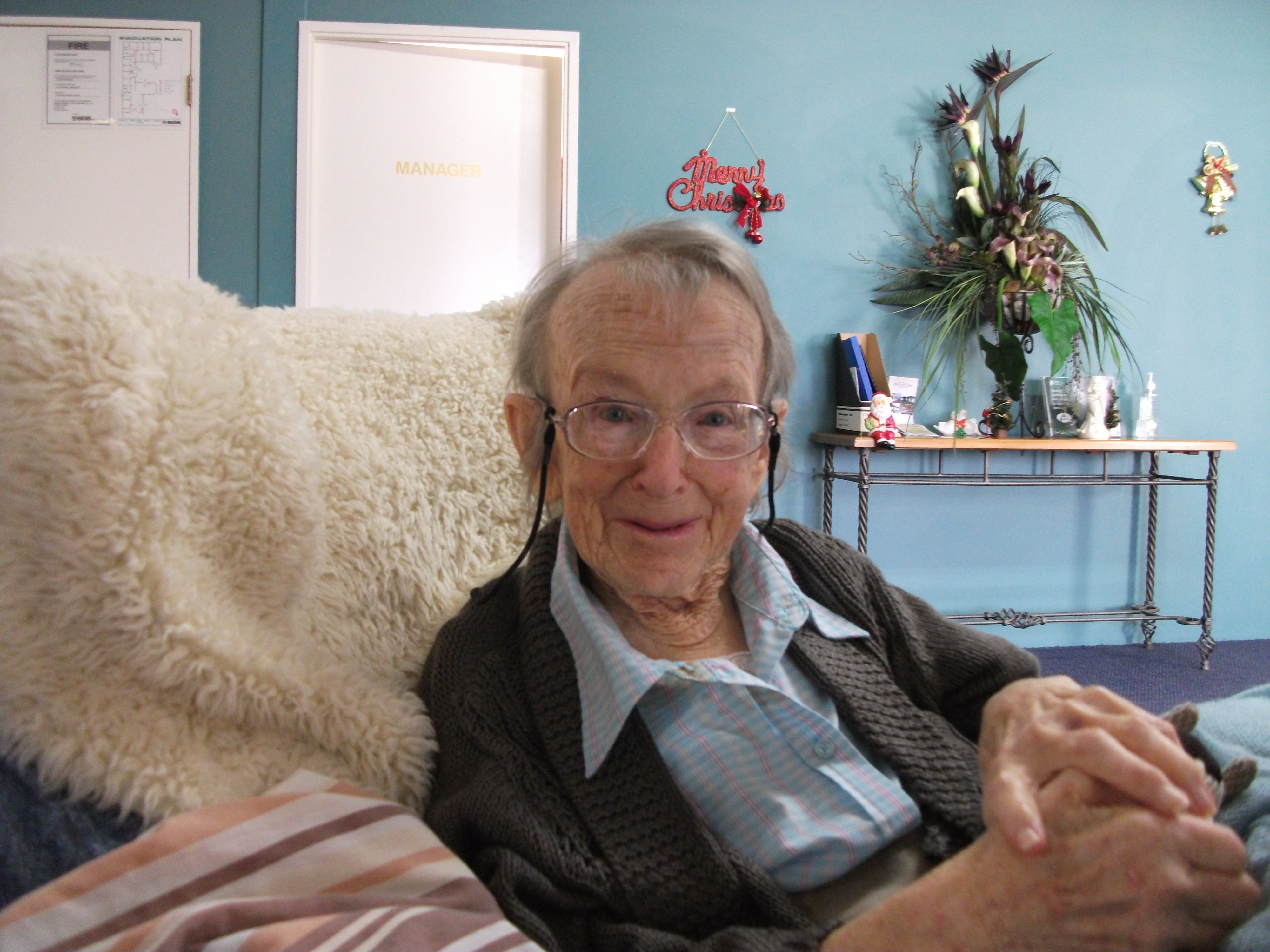
Aunt J looking very alert Christmas day – it's fair to say this is the not person we're dealing with now.
Recently I purchased a few arty magazines from Stampington & Co, because it is cheaper to buy direct from the USA than to buy them here in New Zealand; that’s if I can even find the titles I want. So, I’ve been enjoying the Winter 2011 edition of Art Journaling by Somerset Studios. Yesterday I popped across to Ro Bruhn’s blog and, what do you know, she was blogging about sketchbooks. As I said on Facebook, I had an instant case of sketchbook envy. Then I got to thinking; what is it about Ro’s sketchbooks, amongst others, that make me envious and wanting to do more? I use my sketchbooks, so what’s the issue here?
I spent some time looking at my journals, some online ones, and the pages in Art Journaling and started to see the differences. Often the ones I love use pages that have been prepared ahead of time – smothering them in gesso and acrylic washes ready to work in. Many that I like have stitching and ink splatters, or just lots of layers of work. Yet when I look at mine I tend to want to get the ideas down, visually thinking out an idea, and then move on. It was an “AHA! moment.
I hauled out a 13x21cm sketchbook with a nice weight of paper, and went through it covering all the pages with gesso. When that was dry I went back and edged all the pages in various ways – something else I had realised I love the look of. After that had dried, I started creating some pages, working back and forth, adding paint and collage and ink and my own handwriting. No plan – just working intuitively and, more importantly, keeping working on the pages. And you know what? I now have 3 pages in my new journal that I’m really happy with. They say something to me, say something from me, and are testament to my new working process.
For the record, the page I have scanned is about the recent disasters and how I am overloaded by all the tragedies and taking myself off the news circuit for a few days. A huge step for someone who is normally a news junkie…
A few posts back, here, I showed you a test piece I had done – thinking about ways of presenting information and photos from our Italy trip ready for an exhibition in Wellington in May. In that piece I used a couple of MM foam stamps. I am happy enough with the result but would really like to be using something more personal, something uniquely my own. When I was studying with the Learning Connexion I did some lino cuts and a lot of monoprints. Here’s a couple of examples:
I decided the answer was to take an image from our trip and cut a stencil or make a stamp and use that in the new artworks. The image needed to be something iconic enough that people here in New Zealand would still recognize it even after I had simplified it right down. I had a play with statues, the domes on top of churches, the bridge over the Tiber and the Colosseum. The Colosseum won easily, it is just *such* a recognizable structure. I scanned one of my photos into Photoshop and reduced the level of detail, then turned it to a negative so I could cut out the right parts. I transferred the image onto my lino and got cutting. My first attempt I really liked, but I had forgotten to flip the image and so in terms of my memories of the Colosseum, the building is running the wrong way. Okay. I flipped the image and started again. The end result is quite a different linocut to the first, because that’s the way I work, but I like it. It has energy and it’s mine, not someone else’s idea of the Colosseum.
I wanted to do some more linocuts but had run out of lino, hadn’t had time to get some more, and it’s quite expensive. Today I was watching ‘Acrylic materials and techniques for expressive art with Merle Rosen’ from North Light DVDs. It’s a great dvd by the way, fun to watch and Merle has an exciting art practice. Anyway, part way through I had a total “Aha!” moment. Merle uses old styrofoam packaging to make stamps; it’s cheap (free) and easy to make marks in with scissors, metal tools, old pens etc. How cool is that?
We tend to buy most of our meat from the local butcher. Grant’s old-fashioned, in the best sense of the word, and wraps the meat in brown paper. So no styrofoam meat packaging in our household, but we can always buy some muffins — just for my art practice you understand. In the meantime, here are my first attempts at the Colosseum – these are the linocuts themselves, not the printed images. The images are not perfect and I don’t want them to be; they’ll be used in the background of mixed media works I’m creating over the next month or two.
 I sometimes forget what a profound impact colour has on me though. I read this till about 10pm then spent half the night with possible paintings dancing in front of me, and vivid colour schemes making my brain as far from relaxed as I could possibly get!